
Virginia got out of Lyon just in time. The day after she left, the Germans burst in on her radio operator, Pierre Le Chêne, alias Grégoire, who was in the middle of a transmission. The gonios had picked up his signal. He was taken to the Lyon police station and had the unlucky distinction of being the first SOE agent to be officially interrogated by Klaus Barbie. He was then moved to Fresnes Prison outside Paris and transported to and from 84 Avenue Foch to be interrogated. After being held in solitary confinement for the better part of a year, he was deported to Mauthausen concentration camp, where, unlike many SOE agents, he managed to survive. When the Americans finally liberated the camps, he weighed just 87 pounds (40 kilograms). He eventually returned to England to begin his recovery.
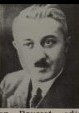
Jean Rousset, AKA Pépin, was arrested five days later, on Friday, November 13, 1942. He was also transferred to Paris and brutally interrogated, and, like Grégoire, never gave up any information about the SOE or Resistance networks. He was deported to Buchenwald, where he helped out in the infirmary.
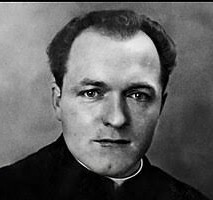
The day after Pépin was arrested, Robert Alesch showed up at his house. Pépin’s housekeeper informed Alesch of the arrest. Alesch hadn’t been aware of it, since at that point in time, he was a double agent with the Abwehr, and it had been the Gestapo who had arrested Pépin. Alesch inquired about Virginia, and the housekeeper told him that she had fled Lyon, but that he could probably find out more information from Germaine Guérin.
Germaine was arrested in January. The Newton brothers, who had been staying with her, recounted that the Gestapo pounded on the door at around 10 o’clock at night. Germaine told the brothers to leave by the back door and that she would deal with the visitors herself. She was taken to Montluc prison, and the next day transferred to Fresnes, where she was interrogated.
Alesch pretended to be sympathetic to the arrests of Resistance members and promised a friend of Germaine’s, Eugène Jeunet, that he would use the brothel owner’s considerable fortune and collection of jewelry to try to get her out of prison. Alesch, naturally, reported Jeunet, who died on a train to Buchenwald. Germaine was brought to the Ravensbrück concentration camp. Meanwhile, Alesch confiscated all of Germaine’s fine things and brought them to his spacious apartment in Paris’s swanky 16th arrondissement.
The Newton brothers held out until the Gestapo caught up with them in April 1943. After enduring weeks of torture, Alfred and Henry were eventually deported to Buchenwald, although both managed to survive.
In June 1945, Virginia returned to Lyon to find out what had happened to her friends. After Ravensbrück was liberated by the Soviets, a visibly weakened Germaine had finally returned to Lyon to find that Alesch had stolen all of her precious possessions and that her friend Eugène Jeunet had perished. No record remains of what had become of her girls, but hopefully they escaped the fates of many French women who were publicly shamed by their countrymen for cavorting with the Germans; the punishment varied from being forced to march through the streets naked, to having their heads shaved, to being tarred and feathered, to being beaten.
Pépin had also returned to Lyon, and Virginia found him at his office at 7 place Antonin-Poncet. He too was emaciated and pale, and told Virginia about the medical experiments he’d been forced to witness at Buchenwald.* Both Pépin and Germaine blamed Robert Alesch for their fates, and one can imagine the sorrow that Virginia felt for not being able to warn her friends.
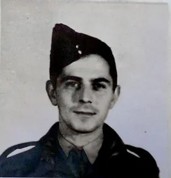
Marcel Leccia, Virginia’s ‘nephew,’ had also been brought to Buchenwald, and Pépin witnessed him and fifteen other men, many of them SOE agents (including Frank Pickersgill and John Macalister, from The Flames of Resistance) being escorted through the courtyard by guards in September 1944. Pépin never saw Leccia again.
For more information about Leccia’s fate, including a ring he had meant to give his fiancée, visit https://www.bbc.com/news/stories-56215177.
Virginia detailed her concerns—along with those of Germaine, Pépin, and the other members of Heckler—about Alesch in a report dated June 11, 1945.
Alesch was already under suspicion even before the war was over. His sister was questioned in November 1944 and admitted that he had worked for Hugo Bleicher of the Abwehr. She also mentioned that her brother would often drop off suitcases stuffed with goods at their shared apartment. When police searched this apartment, they found many of Germaine’s things. Another one of Bleicher’s Resistance/Abwehr double agents, Raoul Jean “Kiki” Kieffer (the same Kiki featured in both The Spark of Resistance and The Embers of Resistance) stated that Alesch had been a trusted agent of the Germans. Alesch, though he proclaimed his innocence, had fled the country. He was eventually brought to trial in France, where members of the Gloria network, Pépin, and his former handler, Hugo Bleicher, all testified against him. He was sentenced to death and was killed by firing squad on January 25, 1949.
*For more information on medical experiments at concentration camps, check out my book The Doctor of Auschwitz
Sources:
Sonia Purnell, A Woman of No Importance.
Vincent Nouzille, L’espionne: Virginia Hall, une Américaine dans la guerre.